

Discrimination on Auto-Pilot
A look at Pierre Poilievre's political tactic that drives divisiveness, discrimination, and deflection from facts.


Pierre built his entire persona around “Axe The Tax,” and it nearly got him “axed” from politics entirely. You’ve probably seen it—a thousand times or more—by now. Now he’s moved on to a proposed deportation plan (announced back in August 2025) that focuses on the “immediate deportation” of non-citizens who commit crimes in Canada.
If that feels troubling, you aren’t alone. And if it feels familiar, that’s because it follows the same pattern of taking a complicated issue, flattening it into a slogan, then sell it as a moral emergency. Both Pierre Poilievre and Danielle Smith engage in this exact behavior, and it should be worrying you.
Back in May 2024, criminal lawyer Michael Spratt described the broader approach by Poilievre like this (might I also suggest reading the full article here):
“Poilievre all but promised to use the notwithstanding clause to bulldoze through legislation that would otherwise violate the Charter of Rights and Freedoms. Because, you know, who needs rights when you have power?”
Familiar? If not, you’ve been under a rock for a while. This is an alarming—and increasingly common—trend among right-wing populist politicians. They treat the Charter not as a guardrail, but as an obstacle to be plowed through when it becomes inconvenient for them, and “inconvenience” seems to be getting in their way more frequently if you have been following politics.
Poilievre has put the mindset into words himself:
“All of my proposals are constitutional, and we will make them constitutional using whatever tools the Constitution allows me to use to make them constitutional.”
Wait, what? If they were constitutional, you wouldn’t need to make them as such. This is not a subtle warning. In a nutshell he is saying “If my proposals don’t survive Charter scrutiny, we’ll use the override.” This is precisely where Canadians should draw a hard line. Repeatedly using (or threatening to use) extraordinary constitutional tools as a political common battering ram isn’t playing fair. It is an active erosion of democracy. It screams “we know what we are trying to do isn’t right, but we don’t care how we get there.”
Even worse, this style of politics doesn’t just bulldoze rights, it weaponizes public anxiety. It takes people who already have strong opinions—often formed through stereotypes, fear, or online misinformation—and reassures them that they were right all along when in actuality, they have never been more wrong. This doesn’t correct bias, it converts it into a campaign strategy. Danielle is actively doing it, Pierre keeps trying to do it, and the end result is large numbers of people that think this is the only way to fix problems now.
Pierre’s deportation pitch pushes a story that encourages suspicion toward immigrants and refugees, painting them as inherently problematic or burdensome. That kind of framing isn’t just ridiculous, it clashes with the basic idea of a pluralistic society where rights and responsibilities aren’t allocated by scapegoating. Canada has always prided itself as a multi-cultural society but these extreme right-wing efforts are attempting to break that down right before our eyes.
I’m not normally a “numbers” guy. The political right thrives on cherry-picked or skewed stats, but it exhausts people and encourages lazy conclusions. Maybe that is the idea? People are burning out from the numbers game. Sometimes the simplest rebuttal is the one that shows the scale of the claim versus the scale of reality.
Before we get to the data, we need to talk about the culture that feeds these narratives.
I spend a fair amount of time in spaces where people have the polar opposite of not only my views, but the polar opposite of reality. A lot of the time, they’re not shy about sharing their opinions on immigration. You see it everywhere—especially online—whenever there’s a news story about a car accident, robbery, murder, fraud, you name it. You don’t have to scroll far to find comments like: “Deport them,” along with others I won’t quote here for obvious reasons.
A certain crowd has convinced itself that every crime is an immigration story.
So why do they think that? Because they feed off each other. Anger spreads faster than facts, and once a person is committed to a narrative, logic becomes optional—especially when blaming “outsiders” is easier than confronting real causes and real solutions. People like Pierre and Danielle know this and they target this exact crowd for support.
That’s why Poilievre’s pitch—“any non-citizen who commits a crime will be immediately deported”—lands the way it does with the targeted base. It is not just misleading, it is designed to activate a certain kind of audience reaction which effectively puts his agenda on auto-pilot while the audience does all of the work. These people gravitate toward each other in person and on-line, they seek each other out because it gives them so-called affirmation.
That isn’t all. The pitch is also misleading for another reason: Canada already has immigration laws that can lead to removal for criminality. So the pitch raises an obvious question: what, exactly, is he changing? Faster processing? Reduced appeals? Expanded categories? More enforcement resources? Those are policy debates. But selling it as if Canada currently lacks the ability to deport non-citizens for serious criminality is nothing more than pandering and political theatre. Something Pierre bases his entire persona around.
Now to the part that matters for the “this is a massive crisis” framing.
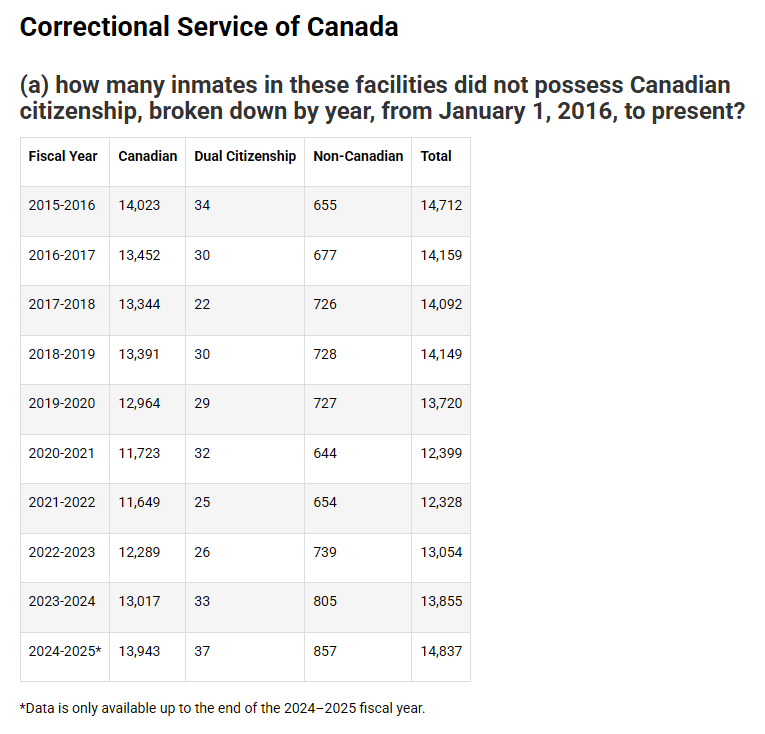
Statistics Canada publishes annual federal corrections data that shows how many people are incarcerated in federal facilities and includes a breakdown of citizenship status. This isn’t hidden or magical data—it’s public. Notably, the request for “inmates without Canadian citizenship” was asked for by Conservative MPs in the House of Commons.
Here are the two biggest ones that matter most:
Blaine Calkins—MP for Ponoka–Didsbury—asked (Q-301) on September 15, 2025 “how many inmates in federal facilities did not possess Canadian citizenship”, with the answer tabled under Sessional Paper 8555-451-301.
Here is that data:
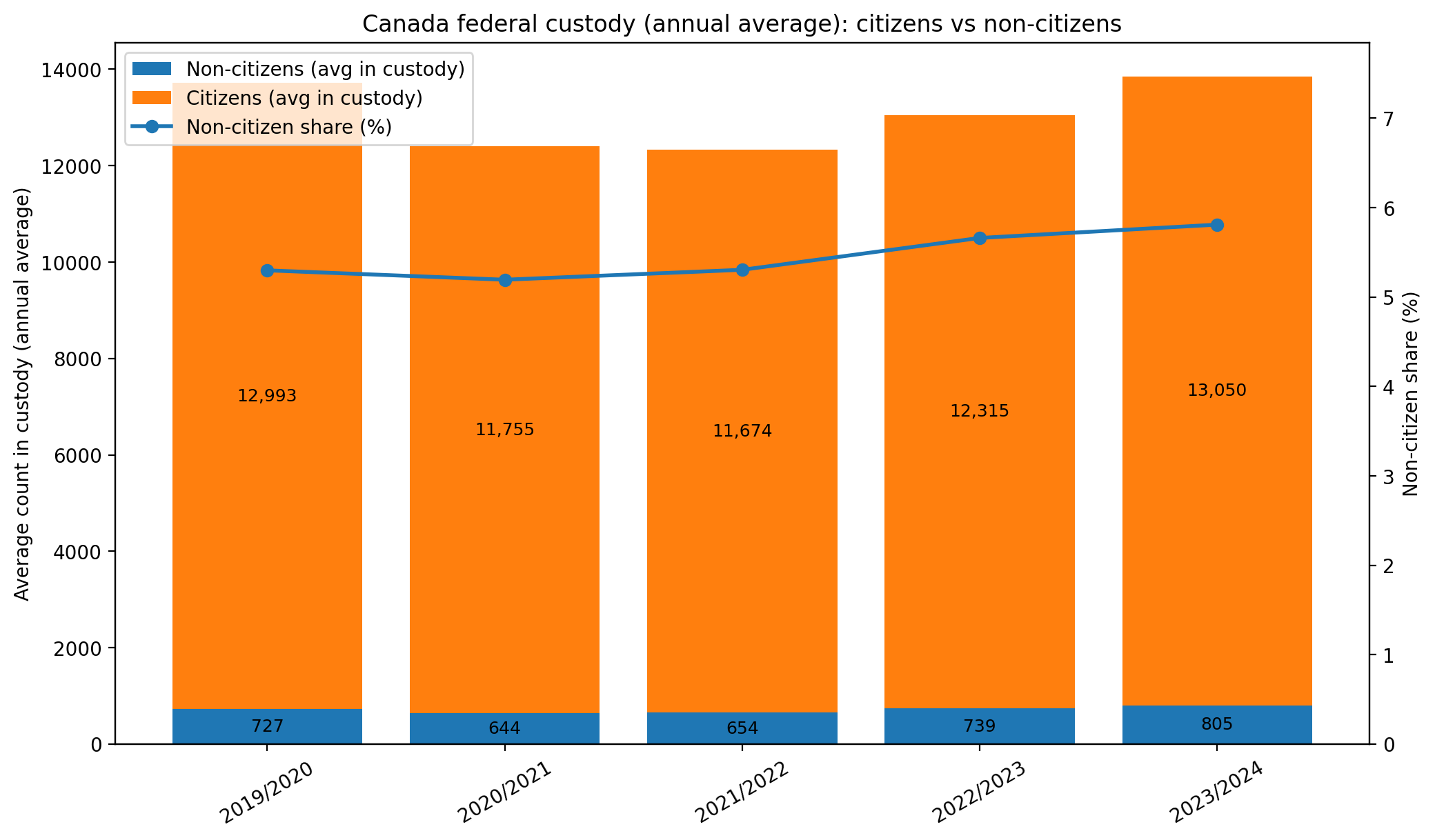
And here is a visual representation of that data:
Then, Michelle Rempel Garner—MP for Calgary Nose Hill—asked (Q-449) on October 9, 2025 about “individuals who, upon release, were immediately detained by the Canada Border Services Agency for subsequent immigration processes.”
Here is that data:
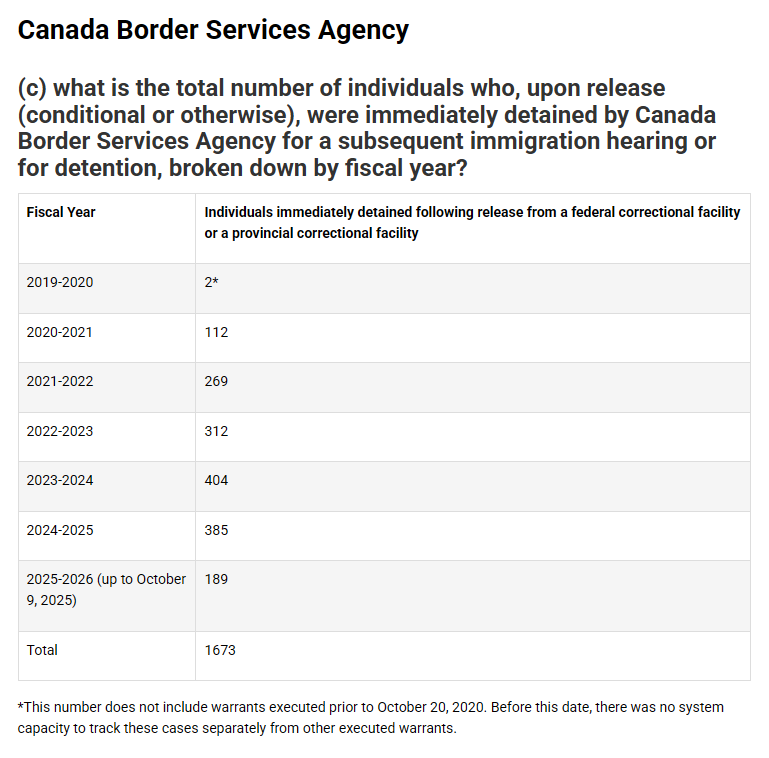
The story those numbers tell is—without any surprise—not the story Poilievre is selling.
Across the last five fiscal years shown in the federal data, non-citizens make up roughly about 5–6% of the federal incarcerated population. In other words: if Poilievre is presenting “non-citizen criminals” as a defining public emergency, the federal incarceration data does not support that framing.
Surprised? You shouldn’t be. This is populist politics in action. They take something small, inflate it into a national threat, wrap it up in discrimination, put it out there on auto-pilot, and then use the resulting fear to justify harsher rhetoric, fewer rights, and more division.
Then it gets even worse when you consider that these people asked for this data. They received the data. The data doesn’t justify the scale of the panic. And yet the messaging continues—because the point isn’t policy precision. The point is to keep a target in the spotlight long enough to turn public frustration into resentment in hopes it will drive votership while the cancerous auto-pilot base continues to grow.
As for provincial custody, citizenship breakdowns are not published in a consistent format that’s easy to compare province-by-province. And perhaps it should be? Perhaps those numbers would also be detrimental to the right-wing agenda. That gap is exactly where irresponsible rhetoric thrives, and they know it. When the public can’t quickly verify numbers or connect the dots, the loudest narrative tends to win.
There is one more important nuance: whether someone is held in a federal facility is largely tied to sentence length (generally, two years or more), while provincial facilities hold remand and shorter sentences. That means federal incarceration stats are not a proxy for “all crime,” and they’re definitely not a proxy for “all immigration-related crime.” Sentencing varies by offence, circumstances, and outcomes—and serious criminality in immigration law can involve thresholds that don’t map neatly onto “federal vs provincial custody.”
But even with those caveats, my point still stands: Poilievre’s rhetoric inflates a narrow slice of reality into a sweeping moral panic while he sells himself as the solution. It hasn’t worked out for him yet, but as the saying goes “throw enough s**t at the wall, eventually some of it is going to stick”…and some of it has already.
When we stop and take a look around and listen to the things people say, read the things people post on social media—it’s everywhere, and it needs to stop.
These extreme right-wing radicals need to go away, and I firmly believe they will. Democracy does always win in the end. We just have to believe in it and not give up.
Thank you.